
Why Portfolio Companies Need Teams of Specialized AI Agents

A single omnibus AI agent deployed across sales, finance, scheduling, and operations inside a $5M EBITDA company tends to fail twice. It botches work outside its competence, and the operator cannot tell which handoff broke.
The cost is a quarter of misrouted invoices and dropped RFPs the humans no longer see.
The fix is not a smarter model. The fix is an orchestration layer: a router agent that dispatches work, specialist agents that own narrow domains, and handoff contracts the humans can audit. Everything else reads as a demo.
The economic question is no longer whether to run AI inside an acquired business. It is how to run many agents so they compound rather than collide, both inside a single operating company and across the portfolio.
Why One Omnibus Agent Breaks at Operating Scale
A $2M EBITDA services business has ten to twenty workflows that matter: quoting, scheduling, A/R, payroll, procurement, inbound sales, warranty claims, vendor onboarding. Pointed at all of them, a general-purpose agent dilutes its own context. It carries a quoting conversation into the scheduling call. It hallucinates a payment term because the prior turn was about warranty. There is no boundary at which a human can intervene, because the failure surface is the whole system.
Gartner's reviewers estimate that only about 130 of the thousands of vendors marketing agentic AI actually deliver it, and that over 40% of agentic projects will be canceled by the end of 2027. For an operating company the failure mode is specific, not abstract. A specialist that fails on quoting can be ripped out and replaced without disturbing collections. An omnibus that fails on quoting may also be the thing booking the service calls. Isolation is the whole point.
The Router Agent Is the Architecture
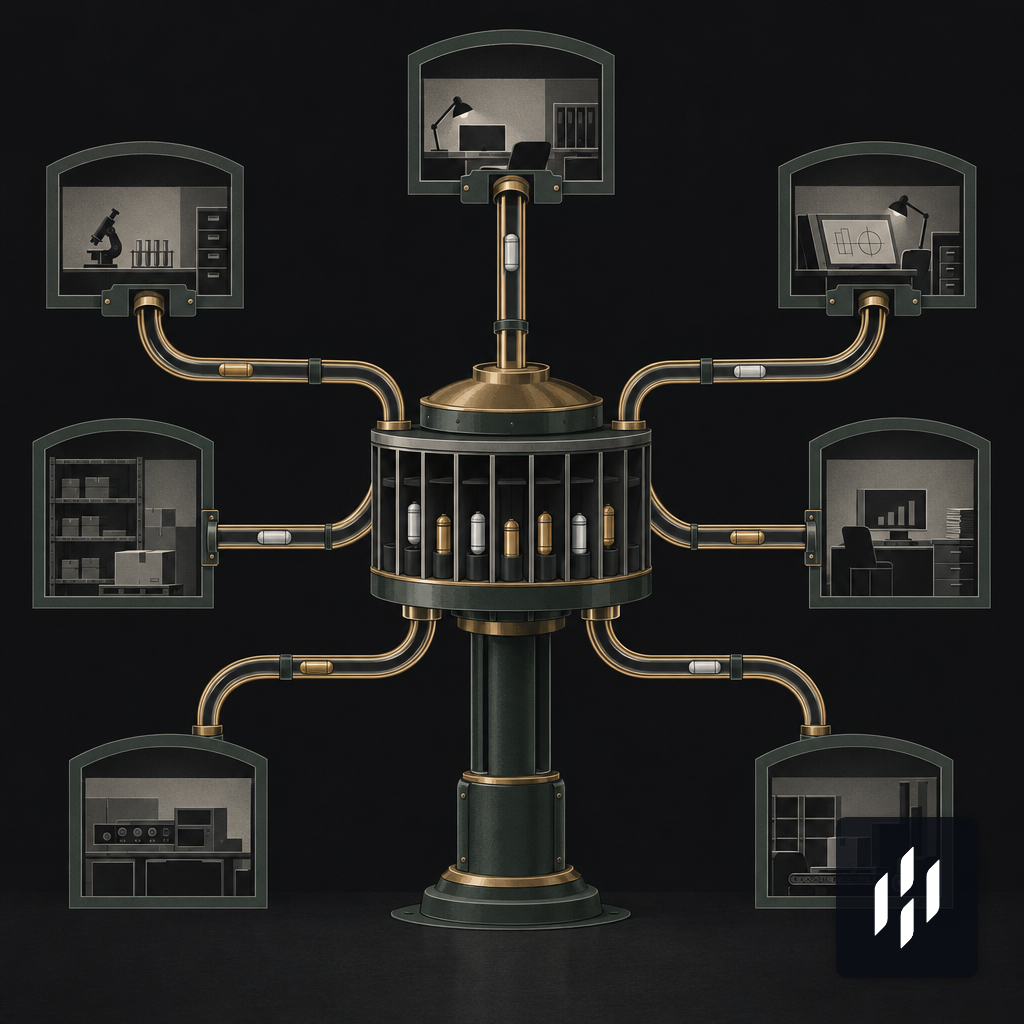
The router is the orchestrator, not the smartest model in the stack. It receives the request, classifies intent, decides which specialist owns the work, and either hands off or fans out in parallel. Specialists do one thing well. A phone agent takes calls. An ERP agent updates records. A listening agent monitors public sources for RFPs. HoldCo has catalogued the specific agents worth running inside a portfolio company; the orchestration layer is what lets any of them scale past a pilot.
Anthropic's own multi-agent research system, a lead Claude orchestrator spawning three to five parallel subagents, outperformed its single-agent baseline by 90.2% on internal research evaluations, at a token cost roughly fifteen times a standard chat. The economics clear only when the work is genuinely parallelizable. Pointed at strictly sequential workflows, multi-agent systems get worse, not better. The shape of that trade-off matters for every automation decision inside an acquired business.
Handoff Contracts Keep Specialists Honest
Every handoff between agents should read as a contract a human can audit: input schema, success criterion, failure behavior, and the escalation address when a value falls outside the expected range. Without one, specialists compound each other's mistakes. The quoting agent returns a malformed object. The ERP agent accepts it. The invoice agent bills the wrong number. The collections agent chases the wrong customer. By the time an operator notices, four systems have agreed with each other in writing.
In practice, the contract is a JSON schema plus a short written SLA. The quoting agent returns a quote object with price, lead time, and confidence; the ERP agent accepts only well-formed quotes above a confidence threshold; anything below routes to a human. IBM's reference pattern for the Model Context Protocol treats the interface between agents, not the model itself, as the primary engineering surface in a multi-agent stack. HBR has reached the same conclusion from a management angle: scaling agents resembles scaling a team, and teams run on explicit interfaces, not shared mind-reading.
Cross-portfolio handoffs are the harder case. A listening agent at the packaging subsidiary spots an RFP a logistics subsidiary could bid. The contract has to carry not only the lead but the permission to route it, the revenue-share treatment, and the fallback if neither company responds in time. That is governance work, not prompt engineering.
Shared Memory Across the Portfolio
A specialist inside an acquired company needs its own context. A specialist at the holdco needs to query across all of them. Shared memory is how a treasury agent sees receivables across every operating company without logging into seven ERPs; it is also how a chief-of-staff agent learns from one business what the others are about to face in the same macro cycle.
The engineering question is scope control. Not every agent should read every memory. HoldCo's prior note on institutional memory argues that the artifact worth preserving is decisions and their rationale, not raw transcripts. The same principle applies to agent memory. A listening agent at a packaging subsidiary should write customer-complaint patterns into a layer the service agent can read; it should not write every internal argument into a store the sales agents consult while quoting. Memory without scope is a privacy incident waiting to be audited, and a legal exposure the long-term owner inherits for the life of the hold.
Human Escalation Is a Design Decision
Escalation thresholds are the second contract: at what confidence level, dollar value, or policy flag does an agent stop and ask a person? Set too high and agents freeze on anything novel. Set too low and the human inbox becomes the bottleneck the agents were meant to remove. Deloitte's State of AI in the Enterprise 2026 survey reports that 74% of respondents expect their companies to use agents at least moderately by 2027, with 23% planning extensive deployment, while noting that agent capability is scaling faster than the guardrails underneath.
In a portfolio context, the threshold is not a single number. It is a matrix: by agent, by transaction type, by dollar amount, by customer tenure. A $150 invoice adjustment for a ten-year customer routes differently than a $15,000 pricing exception for a prospect. A long-term owner should insist on the matrix being written down per operating company before any orchestration layer is turned on, which is the way HoldCo's own agentic AI practice sequences the work: thresholds first, specialists next, router last.
Where This Lands for Founders, Operators, and Intermediaries
For founders mid-transaction, document the automations already running. Which ones depend on a single person's judgment. Which ones have genuine handoff contracts. Which ones are a hallucination waiting for a bad quarter. A long-term buyer will pay for the ones that work and will not punish the broken ones, provided they are named in diligence rather than discovered after close.
For operators inside a recently acquired company, start with one specialist that owns one workflow end to end. A replaced outsourced phone line or a decision between bolting AI onto an ERP or replacing it is the right first proof. Add the router only once two specialists need to pass work to each other; routing one agent is overhead without benefit.
For intermediaries sourcing deals, the question for a seller is no longer whether the company uses AI. It is whether the AI inside it is bounded enough to be transferred to a new owner. Specialists with contracts compound in value through a hold. Omnibus agents leave with the founder who built them.
Considering a transaction?
Speak with our team about an acquisition, partnership, or exit — in confidence.