
Introducing Data.co, The Enterprise Data Platform

Data.co is live as an enterprise data platform aimed at mid-market and enterprise operators. It is not a launch in the venture sense. The product is the formalization of infrastructure that portfolio companies inside hold.co have been running for several years. The thesis is straightforward. Cash-producing B2B businesses live or die on the quality of their operational data, and most of them have not solved it. Spreadsheets grow. ERPs multiply after tuck-ins. Shadow systems accumulate. The reports that reach an owner's desk stop matching what is happening on the plant floor. hold.co has watched this pattern inside its own holdings and in nearly every diligence file it has read.
Why a Holding Company Is in the Data Business
Portfolio companies in asset-heavy sectors generate large volumes of operational data. ERPs log purchase orders and receivings. SCADA systems record cycle times and defect rates. Warehouse management tools track every bin and label. A non-trivial share of institutional knowledge still sits in email. The ERP.io practice at hold.co exists to consolidate this surface area inside the holdings. The Manufacturing vertical runs with the assumption that a shift supervisor's dashboard should show the same number as the controller's close. Neither is possible without a serious data layer.
Owning that layer across a portfolio produces compounding advantages. The same ingestion patterns work at a stamping shop in Ohio and a cold-storage operator in Texas. The same governance model satisfies a medical-device auditor and a defense-adjacent supplier. Decades, not quarters, is the frame the holding company uses. A data platform built once and reused across operating companies earns return on that horizon, not on a three-year hold.
What Data.co Actually Is
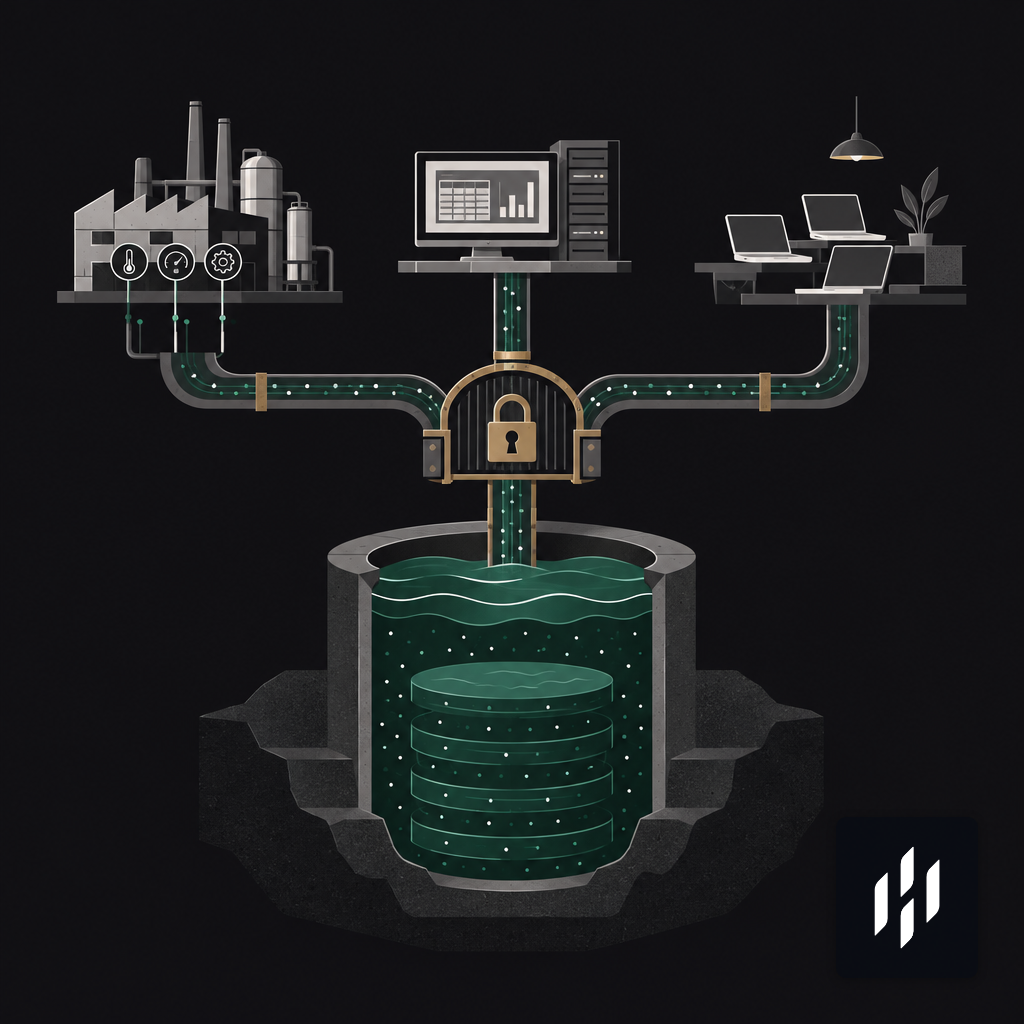
Data.co is an enterprise data platform organized around four capabilities.
Ingestion and pipelines. Connectors for SaaS APIs, relational databases, flat files, and industrial telemetry. Change data capture handles continuous updates. Scheduled batch and event streams handle the rest. Schema drift is detected and routed, not silently swallowed. None of this is novel in principle. The difference is that the connectors were written to survive the specific systems that run industrial businesses, not demo environments.
Warehousing and lakehouse infrastructure. Storage is tiered by access pattern, with cost controls set per workload. Hot, warm, and archival are decisions made per table, not per contract. Open table formats keep customers from being locked into a single vendor's query engine.
Governance, lineage, and access controls. Row-level security, column masking, and end-to-end lineage ship as defaults rather than paid add-ons. This is the difference between a platform a regulated manufacturer can defend during an audit and one that a procurement officer will quietly reject.
An agentic query and automation layer. Operators ask questions in natural language and receive answers grounded in governed data. The same layer triggers workflows. A stockout detection kicks off a replenishment PO. A margin anomaly opens a ticket. Data.co is sold as a platform with flat, predictable pricing. Implementation support is available through the Agentic AI consulting practice when a customer wants hands-on help, but the platform stands alone.
Who It Is Built For
The target customer is a middle-market operator with $20M to $500M in revenue that has outgrown spreadsheets and point tools but cannot justify a Palantir-scale commitment. These companies typically run several ERPs after a decade of acquisitions, a CRM that nobody fully trusts, and a reporting process that eats a controller's week every month. Industry research puts the average enterprise at roughly 897 applications with only 28% integrated. Those unintegrated applications are where Data.co does its work.
The platform is also relevant to family-owned manufacturers consolidating three or four legacy ERPs after a tuck-in acquisition. Pricing is flat and predictable, not a seat-and-consumption meter that rewards the vendor every time a customer gets curious about its own data. The goal is to make the budget line for data infrastructure behave like a utility, not a quarterly surprise.
How It Was Built
Data.co did not begin as a product. It began as internal infrastructure inside the holdings, built to answer a narrow and unglamorous question: why is the headline number on page one of the monthly report different from the number in the ERP. The pipelines, governance patterns, and query layer were hardened across real workloads in asset-heavy operating companies before anyone proposed selling access to them.
This provenance matters. A platform selected for fitness in production is a different object than a platform designed on a whiteboard for a target market. The ingestion library exists because specific connectors had to be written for specific industrial systems. The governance posture exists because specific auditors asked specific questions. The automation layer exists because the alternative was a human operator opening a ticket at two in the morning.
Data.co integrates with the private LLM stack hold.co runs for operators who want model inference against their own governed data. The distinction between inference on a public model and inference on a private one is not academic in regulated industries. The team has written previously on whether operators should add AI to an existing ERP or build native. Data.co is the layer that makes either path tractable.
What This Signals About the Thesis
Why would a long-term holder commercialize data infrastructure rather than reserve it as a portfolio-only advantage? Three structural arguments.
First, scale economics. A platform used by eight operating companies is a cost center. A platform used by hundreds is a business. The unit economics of ingestion, storage, and inference improve substantially with volume, and that volume only appears if the platform serves customers outside the holdings.
Second, diligence quality. Owning the data layer deepens underwriting on future acquisitions. Reading a target's operational systems through familiar pipelines is faster and more honest than reconciling three export files from a seller's CFO. Over a decade of acquisitions, that compounds into a real advantage.
Third, Data.co is a durable, cash-producing B2B business in its own right. Recurring revenue, high switching costs, long contract tails, and a customer base that cannot easily walk away from governed data infrastructure. That profile fits the Target Investment Criteria used to evaluate every acquisition. Governance programs have a famously poor track record. Industry research finds that between half and three-quarters of them fail. A platform built inside operating companies, rather than sold to them, starts from the other end of that problem. Data.co is not a bet on a particular AI trend. It is an investment in the pipes every operator will need regardless of which model vendor wins the next cycle.
Availability and the Long View
Data.co is available now. Prospective customers and intermediaries can reach the team through the hold.co contact page. The long view has not changed. The platforms that endure are the ones measured in decades, not funding rounds, and operational data is one of the few assets inside a B2B business that compounds for its owner at precisely that horizon. The signal worth watching, for Data.co customers and for the holding company itself, is the share of a portfolio company's operating decisions made against governed data rather than against an exported spreadsheet. If that share stalls below a majority after a full year on the platform, the implementation is not working and the thesis should be revisited.
Considering a transaction?
Speak with our team about an acquisition, partnership, or exit — in confidence.